
SARAHCROWN in conversation with Pippa El-Kadhi Brown
Pippa El-Kadhi Brown, and Her Kaleidoscopic Portals into the Mind’s Eye
SARAHCROWN: Tell us a bit about when and how you decided to become an artist? And have you always been a painter?
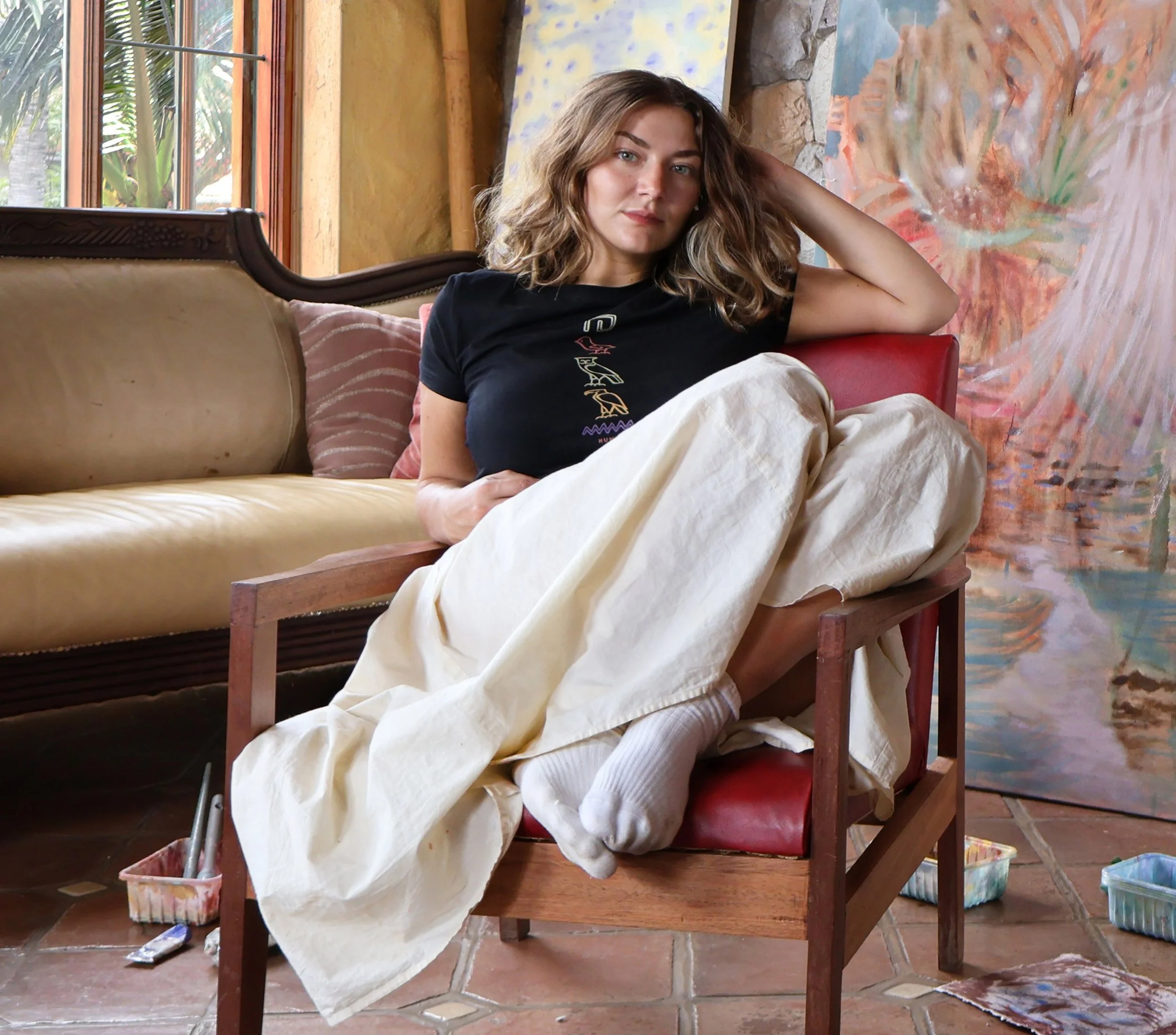
Pippa El-Kadhi Brown in her temporary Nairobi studio (Spring 2026)
PIPPA EL-KADHI BROWN: As a child I was always fascinated by world-building. I would spend hours playing video games and arranging funny little anthropomorphic figurines to create these strangely functioning little environments. Painting feels like a continuation of that playful childhood instinct, creating these strangely functioning atmospheres that exist somewhere between emotion, memory and lived experience.
Being creative has always felt very natural to me, so the idea of becoming an artist had always been not only extremely alluring, but actually felt almost vital. This possibility of developing my own visual language, and the freedom to challenge and understand the world around me through it, has always felt incredibly important.
I’ve spent my adult life developing my visual language with a large focus on painting, and I still feel it’s constantly evolving as I come to understand it better each day. Although I also enjoy the vigor of drawing, and I’d love to explore sculpture and installation more, painting has always felt like my most natural outlet. I love its versatility and its ability to be fluid and static, physical and emotional, muted and vibrant, all in one mark. It has the capacity to be a million things at once.
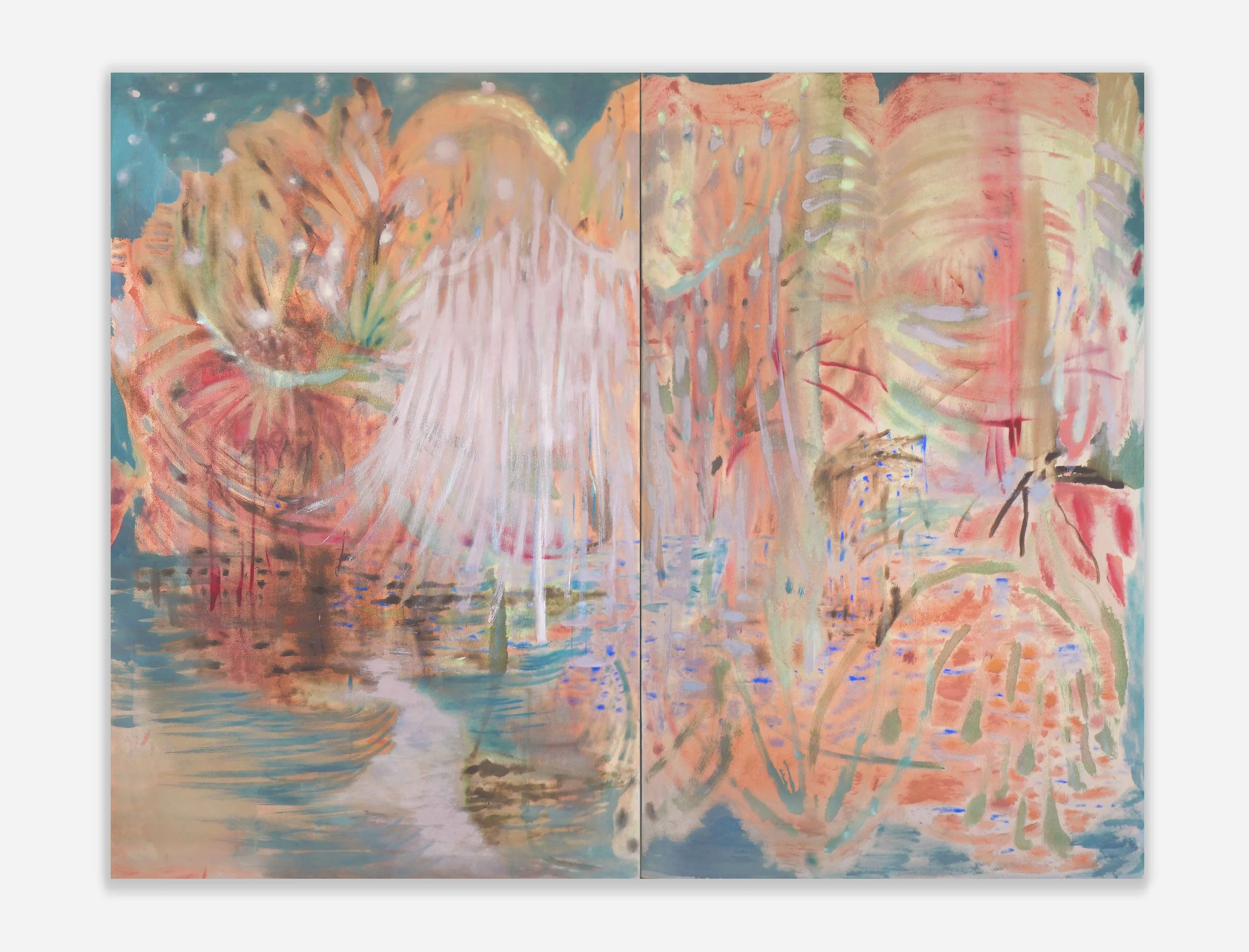
Pippa El-Kadhi Brown, She Comes in Waves, 2026, Oil on canvas, 150 x 200 cm
SC: You’ve mentioned once about your paintings that “they function as portal’s.” Considering your international travels, residencies, and personal multi-cultural heritage, do you imagine these paintings to be portals to somewhere earthly?
PKB: I think the works are both earthly and unearthly. They’re shapeshifters, made up of many moments, places and experiences simultaneously, so in that sense they are in a way rooted in spatial experience. I’m interested in the way the mind conjures imagery from an archive of lived memories, so fundamentally the paintings are grounded in human experience.
The process of making them involves dipping into the subconscious and creating a kind of Frankenstein monster made from a kaleidoscope of experiences at once. Because of this, the paintings feel more so psychological or emotional than physical representations. They hover between abstraction and figuration, playing with the mind’s tendency to recognize forms, spaces and narratives where none are explicitly defined, creating these strange new environments which are built from many things at once.
Like diary entries, they become portals to states of mind or hazy memories, formed through an unlimited combination of experiences and different parts of myself. Often it’s only weeks or months after finishing a painting that I might begin to identify particular places or moments that have naturally filtered into the work and shaped it into what it is.
Acatenango (2024) was named after hiking Guatemala’s Acatenango volcano and witnessing Volcán de Fuego erupt ferociously alongside. At the time the painting wasn’t intended to be based upon that landscape, but afterwards it became clear how deeply that experience had seeped into the work. Around that time many of my paintings began to develop this volcanic quality. The works began to billow, erupt and gurgle. The paintings become portals to these moments, but the moments themselves are constantly shifting, reforming and dissolving.
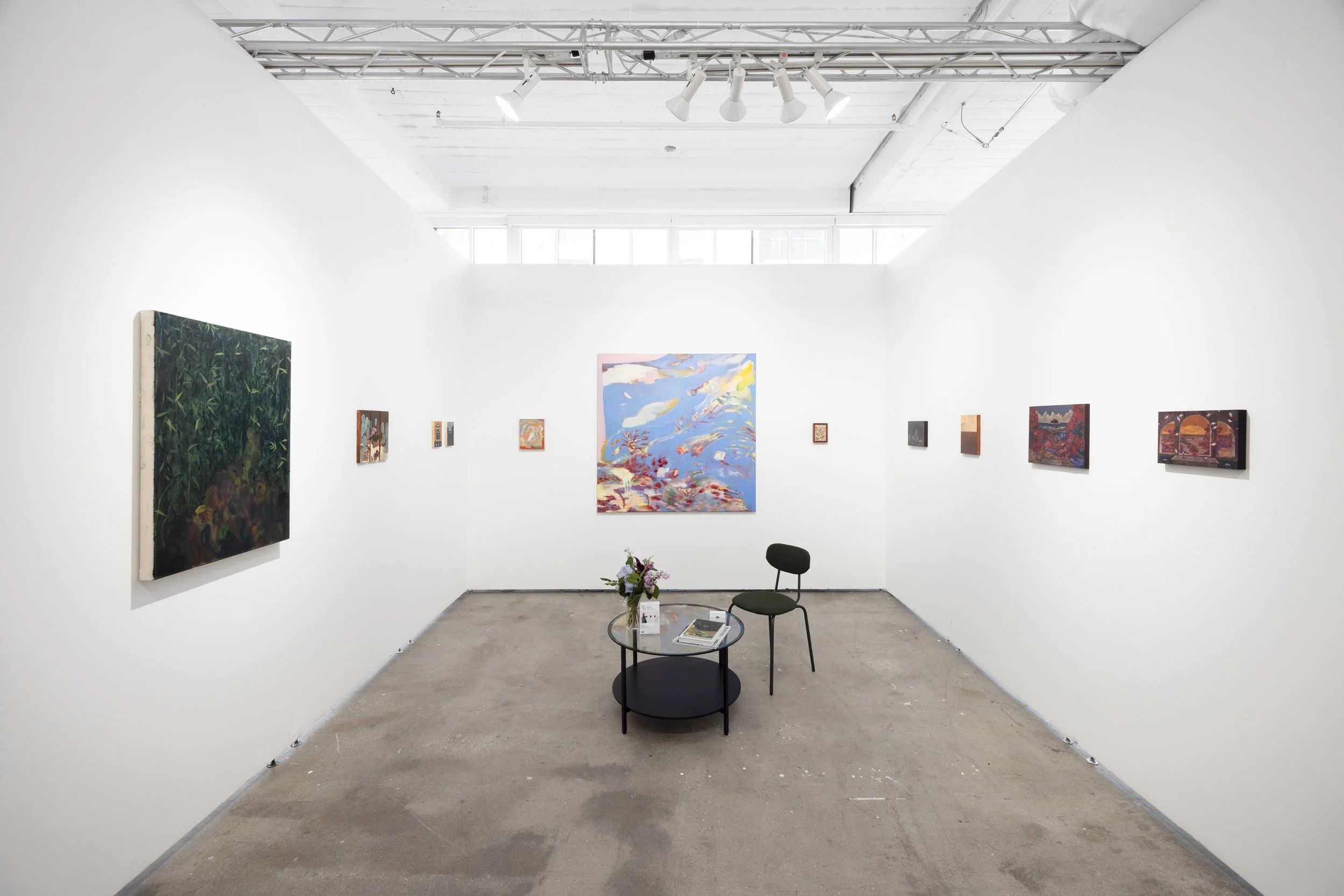
Acatenango (2024) pictured centered at SARAHCROWN‘s 2026 NADA New York presentation
SC: Looking at your series, it appears that each painting is made with a color palette of similar colors, rather than using stark contrasts. Is this intuitive? How do you decide on a color palette?
PKB: I work across several paintings simultaneously, so the colour language naturally moves and dances between them. I’m drawn to palettes that feel airy and playful, often using shimmering blues and kitsch sometimes saccharine pastels. I like the work’s surface to feel almost worn, like slightly faded bedsheets, blurred vision or hazily remembered daydreams. I tend to reach for colours that sing a somewhat fantastical song and can feel quite strange and otherworldly. I often think of playing those old video games and this notion of being transported to strange dreamy realms made up of these fantastical hues that feel almost magical.
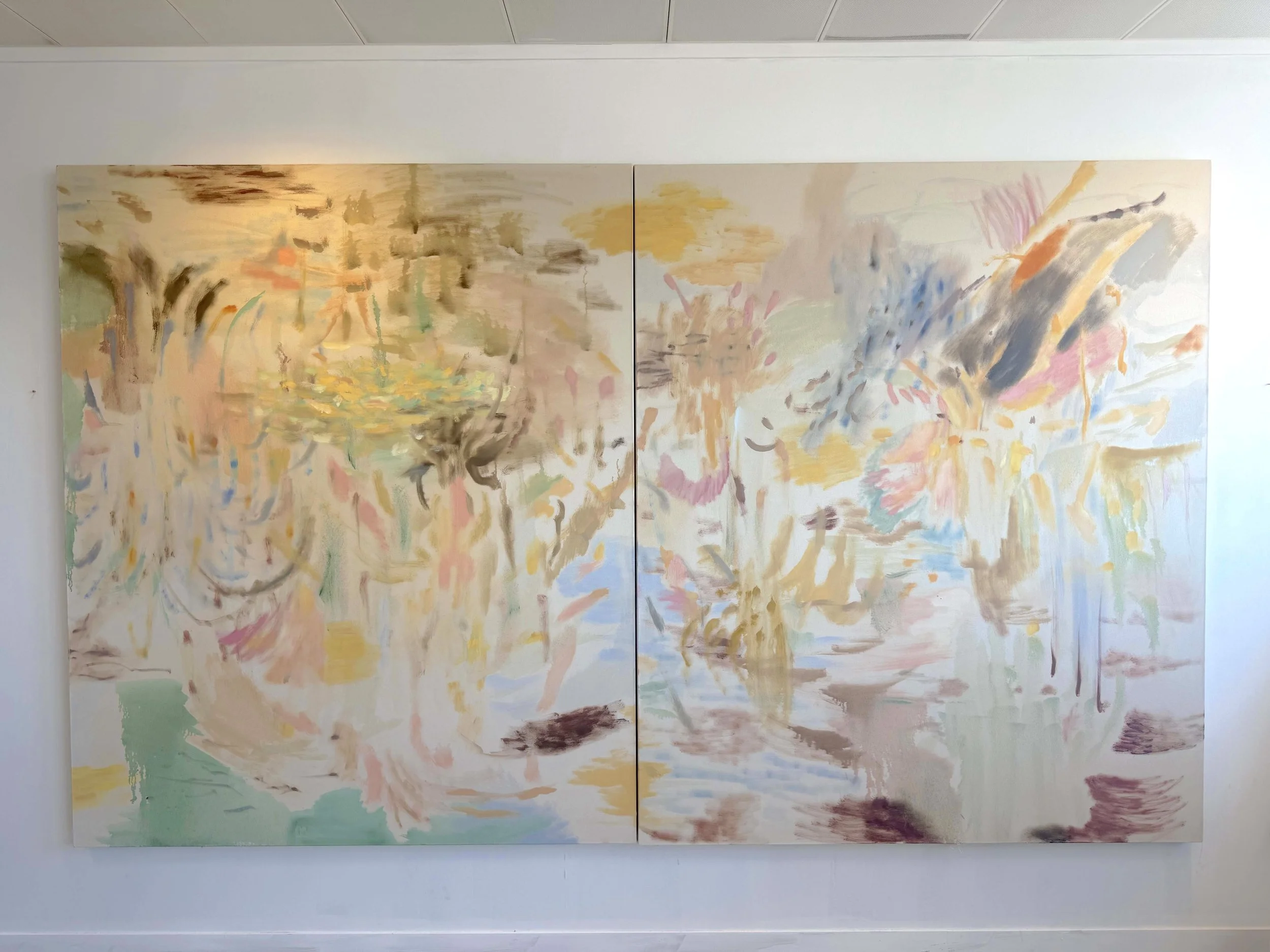
Studio view of a work in progress, London, 2026
There is a childlike playfulness in my choice of palette, a colour behaviour which carries a sense of wonder and nostalgia. More recently, the pastel palette has been joined by more organic browns and greys. I’m becoming increasingly interested in the dialogue between these muted pastels and these muddier, murkier, bruised, earthy stains. I’m enjoying the introduction of more organic, and in some cases perhaps lightly sinister, undercurrents beneath an otherwise playful and joyful colour language.
SC: Your work varies greatly in scale, moving between very large canvases and very small ones. Is there is a canvas size you prefer to work on?
PKB: There is a physicality to working on a larger scale that I really adore. I enjoy how my entire body becomes involved in making marks, with punchy clunky stabs and sweeping gestures recorded across the canvas in real time. The larger scale also physically mirrors the space around me, allowing moments to pulse and erupt across the surface, while still leaving airier pockets for quieter passages to breath.
I often begin the large paintings with the canvas lying flat, allowing the paint to pool, spread and spill across the surface. I enjoy the ability to move around the canvas, approach it from different angles, and allow the painting to develop through movement rather than from a fixed viewpoint.
This physical relationship with the canvas feels important. The work is built through gesture, movement and a constant re-negotiation between myself and the painting. There is an ongoing conversation with the act of painting itself: pressure, opacity, weight, rhythm, figuration and materiality.
I also love the process of working on a very small scale. The tiny works have a different dialogue to their much bigger sisters. Whilst they are much smaller in size, they are often much denser and can hold so much weight. They can often feel both microscopic and galactic at the same time in a different way to the larger paintings. I love the conversation between the distinct scales, and how they almost playfully tease and complement one another. Showing the contrasting scales beside one another creates a really lovely dialogue, where each seems to shift how the other is experienced.
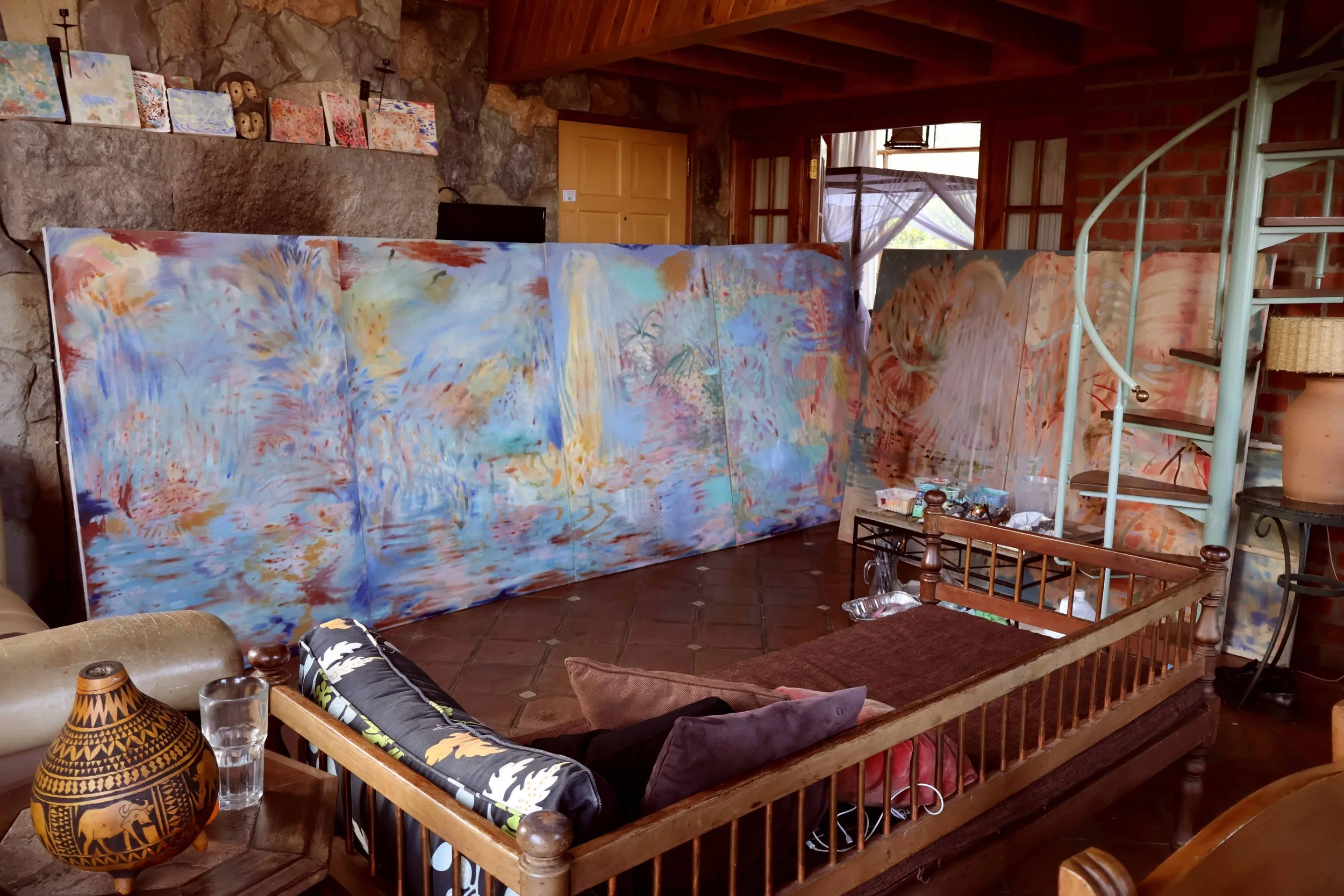
Studio view, Nairobi, 2026
SC: The environment of a studio, a community, even a headspace, can be very influential on an artist’s work. Do you think the residencies you did changed your painting style?
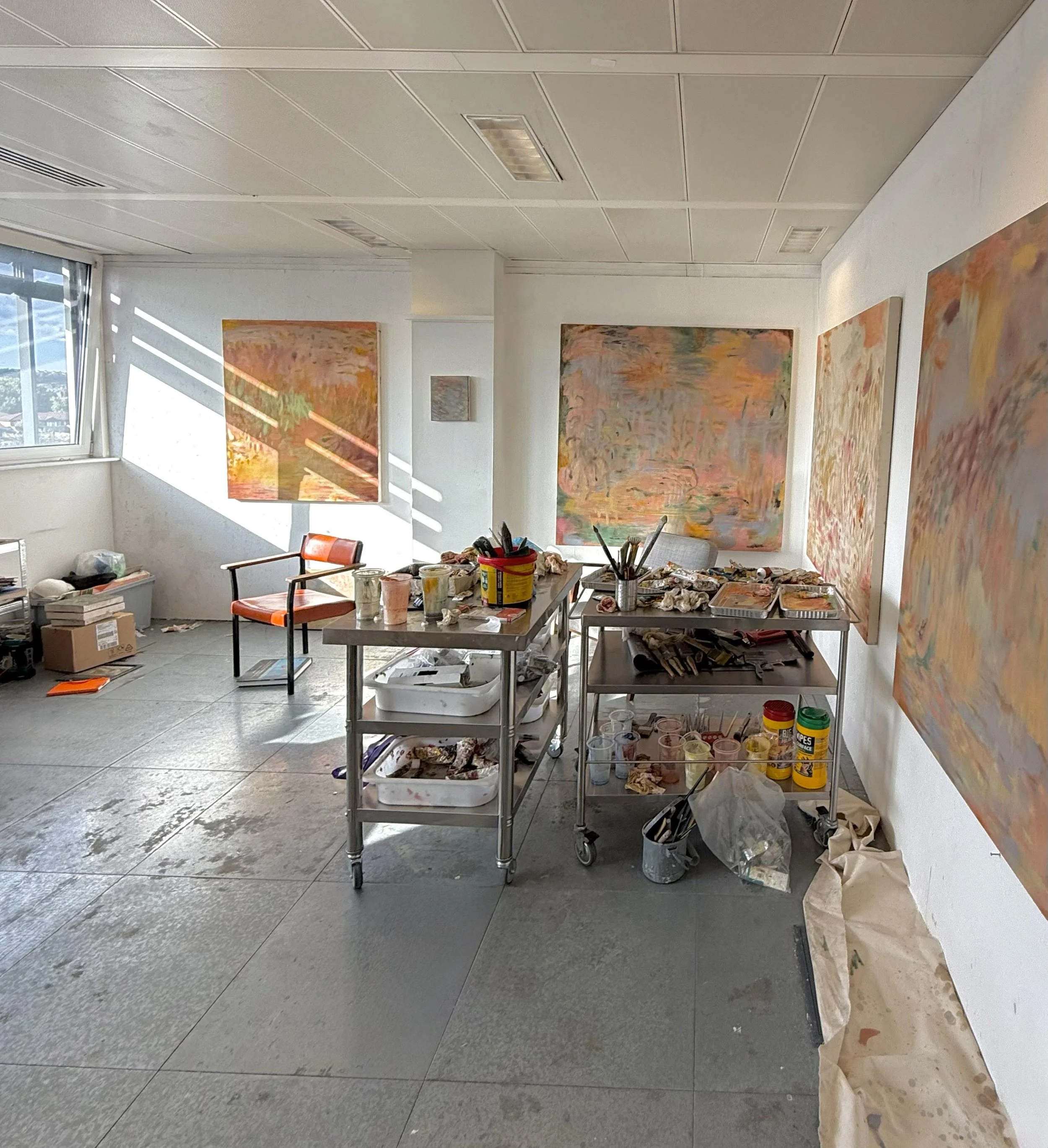
Pippa El-Kadhi Brown - Studio view. London, 2026
PKB: The residency that had the biggest impact on my practice was my year-long Freelands Foundation Fellowship, hosted at Manchester School of Art in 2024/2025. Working independently within an art school context, while existing somewhere between tutor and tutee, gave me the opportunity to challenge my practice within an incredibly supportive community. This symbiotic nature of my time there fundamentally changed my understanding of and approach to painting. I began relinquishing more control and allowing the work to evolve more fluidly, both conceptually and materially. Rather than forcing paintings towards predetermined outcomes, I became much more interested in allowing them to reveal themselves through the process.
I think my environment has an enormous influence on my work. Like the paintings themselves, my studio has also been something of a shapeshifter over the last few years, as I’ve moved from studios across the UK, northern and southern Italy, and most recently Kenya.
Everything affects the paintings - the temperature, the light, my mood, the communities around me, the sounds, routines and imagery that I encounter daily. Our minds are constantly collecting material, and the paintings inevitably absorb it in ways that often remain unnoticed until much later.
In my recent body of work made during four months in Kenya, I was painting amongst palm trees brushing up against the window in the intense warmth of the equatorial sun. There was a constant chatter of tropical birdsong, and I would spend weekends amongst incredible wildlife and gawking at nature’s wonders, visiting vast landscapes, gushing waterfalls and experiencing intense thunderstorms, heavy rain and severe flash floods. The paintings took on a sort of flooded quality themselves; the surfaces began to feel simultaneously dry and wet, whilst a hazy atmosphere emerged - Nairobi’s soft, diffused light has also undoubtedly filtered into these paintings, and I suspect more recollections will continue to resurface in future works.
SC: You talk about your paintings as “an excavation,” an exploration of the “thingness of existence.” Can you share more about this?
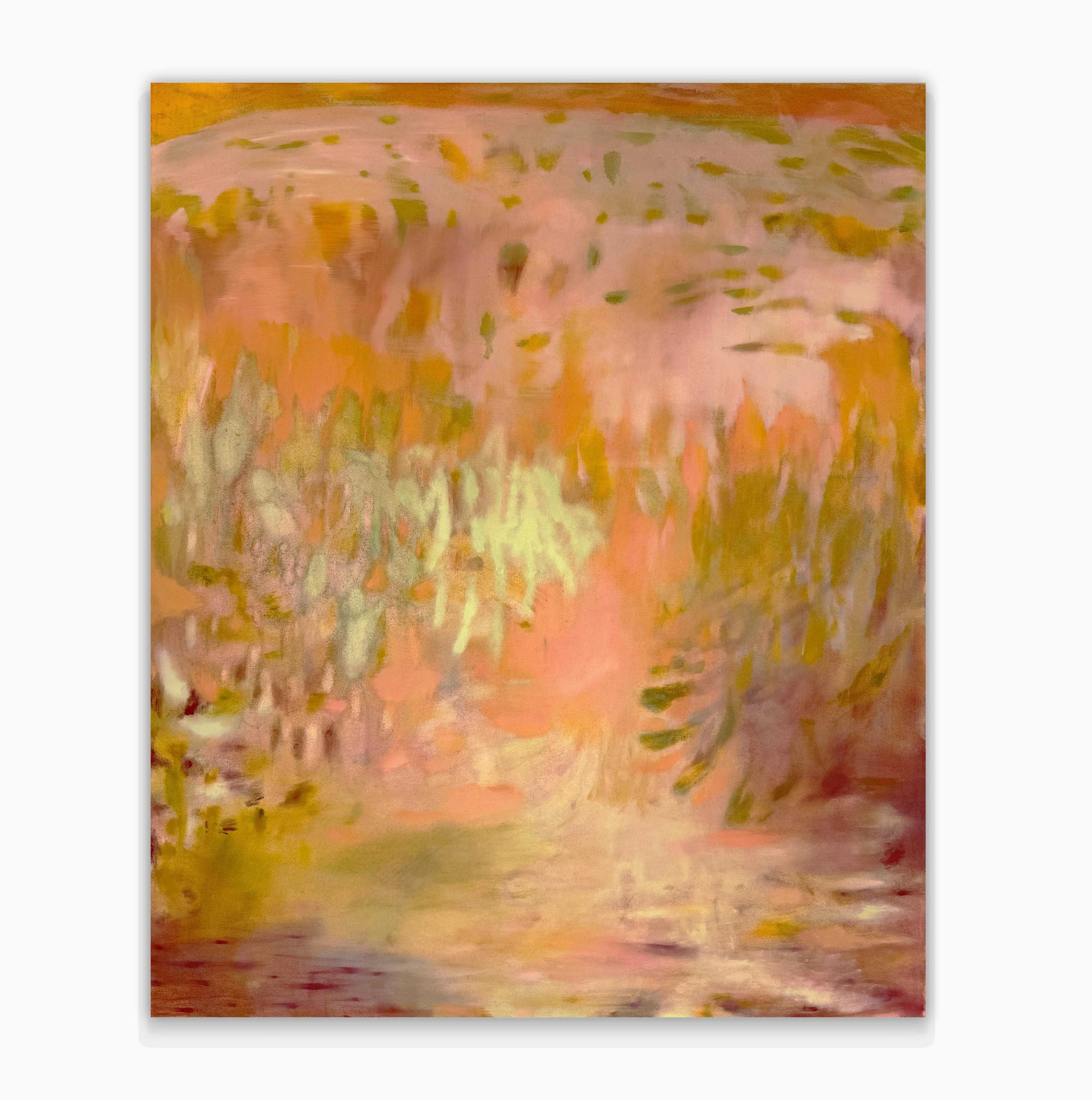
Pippa El-Kadhi Brown, Moth to a Match to a Flame, 2026, Oil on canvas, 117 x 97 cm
PKB: Excavation is a process of uncovering, of slowly revealing traces, fragments and sensations that are inherently embedded within the act of painting. The paintings begin with initial gestures, gradually suggesting fragments of forms. I want the imagery to emerge slowly, as though it is being unearthed. I allow these forms to flicker and emerge, while also resisting the temptation to resolve them too quickly or absolutely.
Ultimately, the painting begins to tell me what it needs, and eventually certain marks begin to assert themselves, and I choose to give selected forms agency. Air, space and atmosphere start to dictate an abstracted sense of place, and these psychological environments gradually begin to unfold. The excavation happens throughout the entire process, from laying down paint, to carving forms back out of it. It is a way of allowing something to surface gradually, rather than imposing a preconceived image or idea onto the work.
This excavation is also an effort to get closer to this thingness. In a phenomenological sense, this ‘thingness’ is about searching for the underlying presence. Not to fully represent specific objects or places, but to uncover something of their essence, as they exist in this continual state of becoming. I’m interested in the point before forms become fixed or named, where they exist first as sensation, atmosphere or feeling. This thingness is that quiet weight of being before experience settles into form, language or certainty. Something that exists between matter, memory and emotion. The paintings become a kind of accumulation of these lived experiences in an ongoing archive of sensations, impressions and states of mind, both internal and environmental.
SC: One of the wondrous things about figurative abstraction is its ambiguity. How do you hope a viewer feels looking at your work? Is considering the reception at all part of your painting process?
PKB: I’ll admit that what I get from painting can feel almost selfish at times. The enjoyment I find in the painting process, especially at the very beginning of a new work, is so absorbing and pleasing that it’s almost easy to forget about it being interpreted by anyone else. Of course I think about the viewer, but I try not to let those thoughts alter the direction of the work too much. One of the things I love most about painting is that every individual will inevitably experience it differently and in their own way. I don’t expect and wouldn’t want viewers to fully perceive each work as I do.
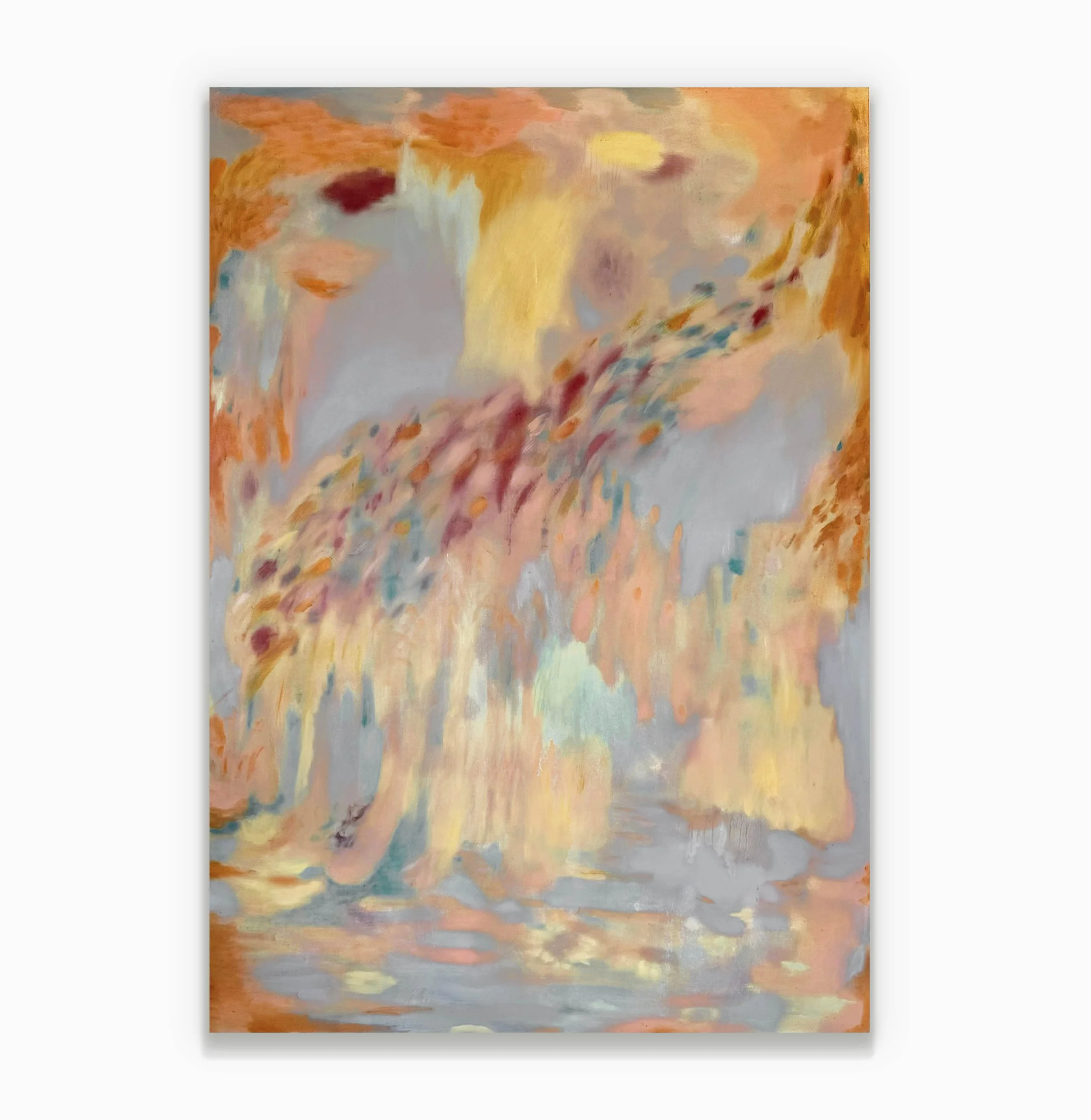
Pippa El-Kadhi Brown, 2026 - Work in progress
I hope the paintings evoke a sense of wonder and curiosity. I want them to transport the viewers into a space where they can linger, perhaps project their own experiences and potentially discover something that might feel strangely personal to them, be it a physical or emotional. If the work can hold the viewers gaze and provoke a sense of curiosity, then I would feel satisfied by how they are received.
SC: Is there anything else you would like to share about your practice?
PKB: For me, painting is a continual process of becoming rather than arriving somewhere fixed. Each work teaches me something about the next, and each body of work reshapes my understanding of what painting can do. I’m interested in a practice that remains open to uncertainty. That sense of not having full control, of allowing the work to surprise me, is what continues to keep the work feeling human, honest and exciting.
——————————
ABOUT THE ARTIST
Pippa El-Kadhi Brown (b.1996, London. Lives and works in London)
Brown graduated from MA Painting at Royal College of Art (2022), after studying BA Painting at The University of Brighton, School of Art (2018).
Pippa El-Kadhi Brown has received a number of notable awards and recognitions, including the Freelands Foundation Fellowship Award (2024) and selection as a finalist for Bloomberg New Contemporaries (2023). Earlier distinctions include finalist positions for the Global Design Graduate Award and the Chadwell Award (both 2022), as well as the Ashurst Emerging Artist Prize (2020) and the Ali H. Alkazzi Scholarship Award at the Royal College of Art (2020). Additional accolades include the Art Pegazs Taste of Life Award and the Creekside Graduate Studio Award (2019), alongside finalist recognition for both the Platform Graduate Award and the Rising Talent Award (2018).
Pippa El-Kadhi Brown has developed a consistent record of solo and group exhibitions internationally. She was recently a part of The Hug, a group exhibition at SARAHCROWN New York (2026) and participated in Ways of Seeing at the Rothko Museum in Daugavpils (2026). Prior presentations include Stranger Skies at Holden Gallery, Manchester (2025), and Haunt at Ed Cross Gallery, London (2024). In 2023, she presented two solo exhibitions in London: Walls Who Whisper at Lychee One and Vista at Lamb Gallery. Earlier exhibitions include Where the Dust Settles at CBU Gallery, Taipei (2022), Around You, Within You, Or Nowhere at All at Ashurst, London (2020), and House Plants at Creekside Projects, London (2019). Notable residencies include: Palazzo Monti, Brescia, IT (2025), Tabari Art Space, La Serena, IT (2025), Freelands Foundation Fellowship Residency at MMU, Manchester (2024-25), Organhaus Studio, Chongquing (2019); Creekside Artists Studio, London (2019).
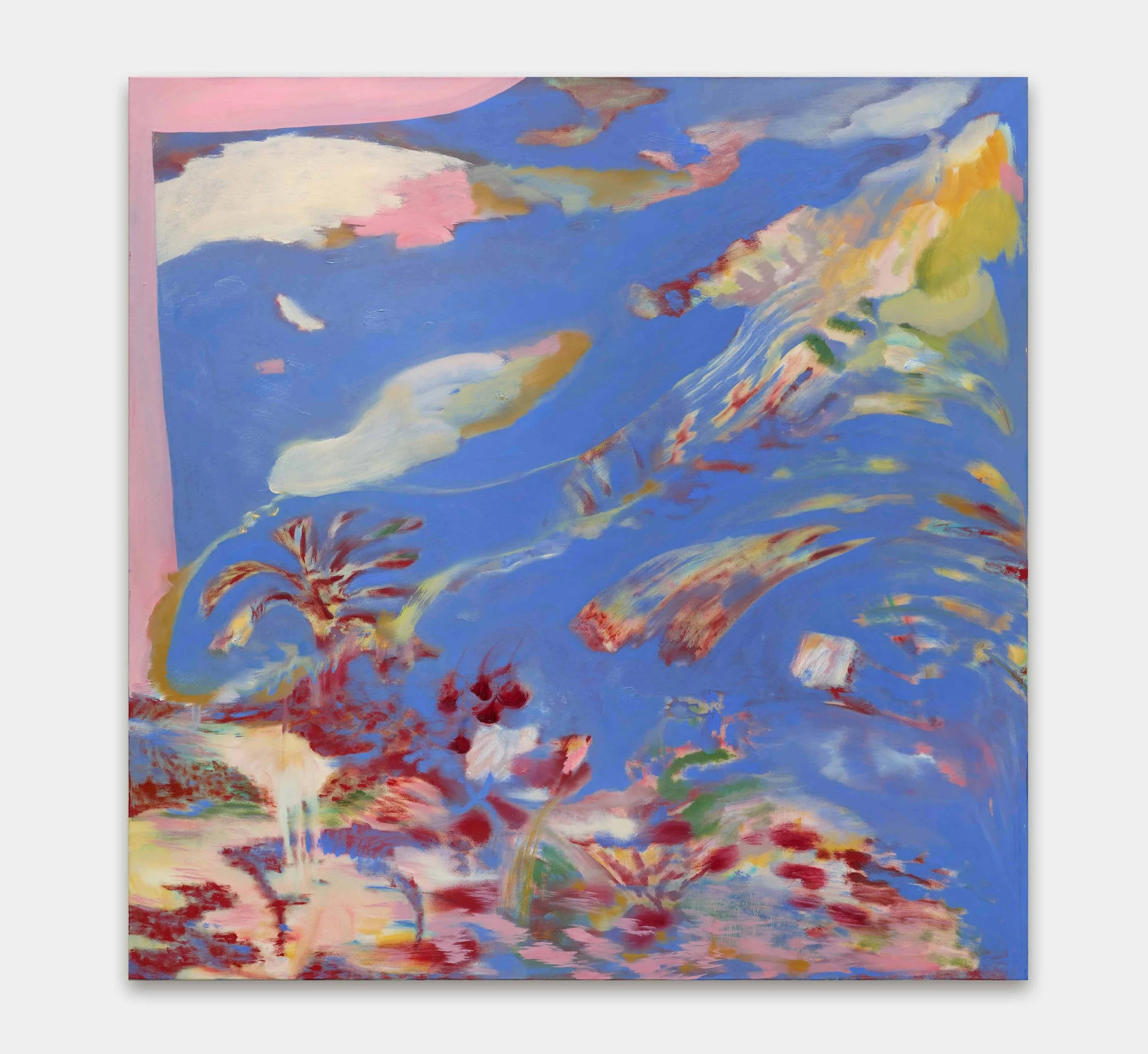
Pippa El-Kadhi Brown, Acatenango, 2024 Oil on canvas, 58.1in x 58.1in, 147.5 x 147.5 cm.jpg, Image courtesy of SARAHCROWN and The Artist