
 Image 1 of 1
Red, blue, turquoise and graphite pencil, pen and ink on Canson paper. 11 2/5 × 16 1/2 in | 29 × 42 cm | Frame included
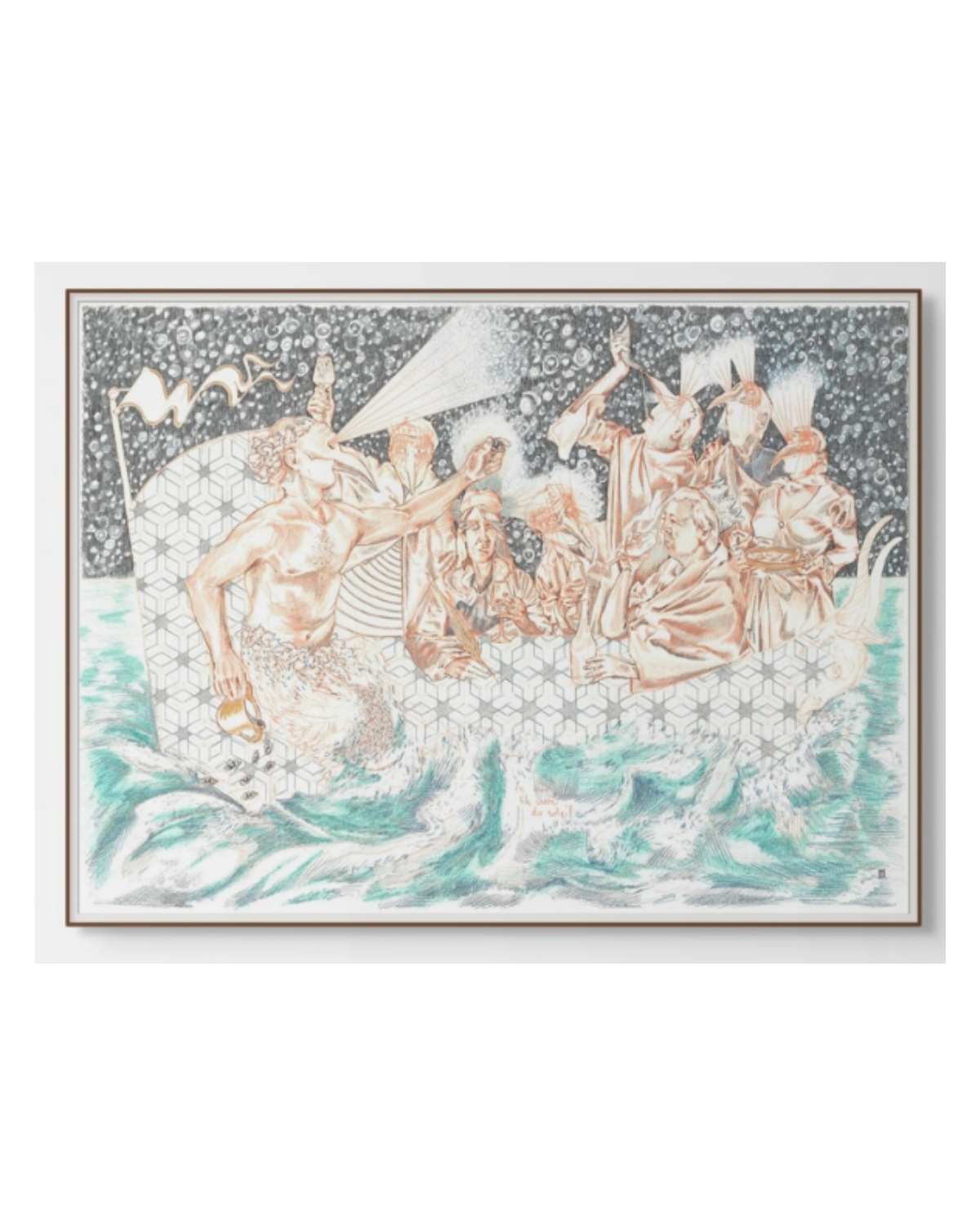
This drawing was inspired by the Ship of Fools. As a medieval archetype, this mysterious vessel typically housed the outcasts of society—those who defied moral limits and stepped outside sociological boundaries. From the Middle Ages to the present day, the Ship of Fools was commonly called "das Narrenschiff," which lends its name to the moralistic allegorical satire written by Sebastian Brant in 1494 in Basel. Another name for the ship is "Blauwe Schuyt," referring to the large carnival procession ship (carrus navalis) that traveled through the cities of the Netherlands (today's Belgium and the Netherlands) and Germany on Carnival Day. Depelchin uses the ship as a symbolic vessel bearing his most important artistic leitmotifs: the feather and the ring (both symbols of gravity and spherical attraction), the flag (a symbol of movement), and the cup (a symbol of sacrifice and libation).
Red, blue, turquoise and graphite pencil, pen and ink on Canson paper. 11 2/5 × 16 1/2 in | 29 × 42 cm | Frame included
This drawing was inspired by the Ship of Fools. As a medieval archetype, this mysterious vessel typically housed the outcasts of society—those who defied moral limits and stepped outside sociological boundaries. From the Middle Ages to the present day, the Ship of Fools was commonly called "das Narrenschiff," which lends its name to the moralistic allegorical satire written by Sebastian Brant in 1494 in Basel. Another name for the ship is "Blauwe Schuyt," referring to the large carnival procession ship (carrus navalis) that traveled through the cities of the Netherlands (today's Belgium and the Netherlands) and Germany on Carnival Day. Depelchin uses the ship as a symbolic vessel bearing his most important artistic leitmotifs: the feather and the ring (both symbols of gravity and spherical attraction), the flag (a symbol of movement), and the cup (a symbol of sacrifice and libation).